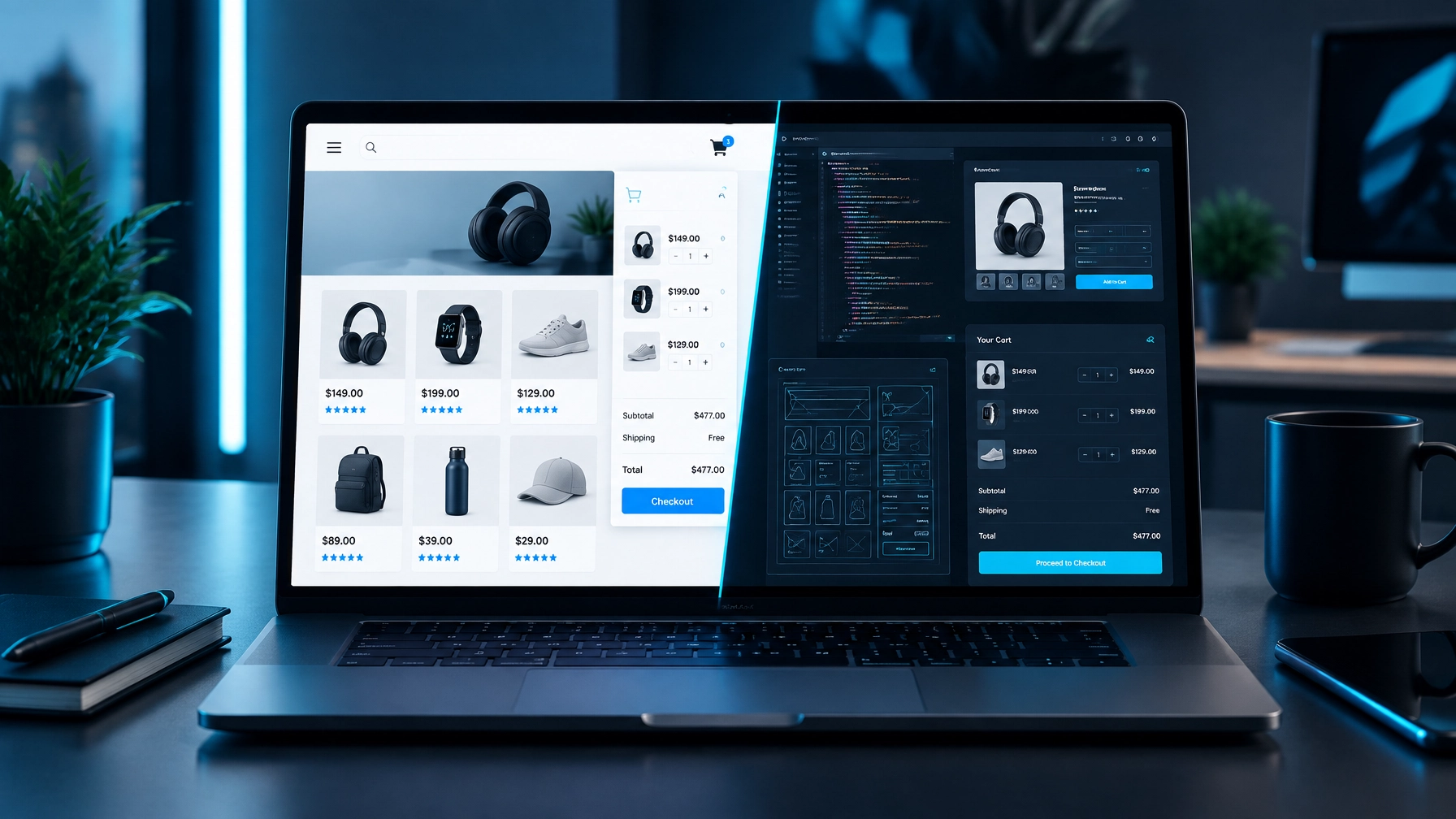
Shopify vs. Custom Ecommerce Development: Which Is Better For Your Store?
- Harris Digital
- October 5, 2026
- Blog
Choosing an ecommerce platform is a business decision, not only a technical one. The platform you select influences your launch timeline, operating costs, page speed, SEO flexibility, checkout experience, integrations, and ability to scale.
For most growing brands, Shopify offers the fastest path to a reliable, conversion-ready store. A custom ecommerce build can be the stronger choice when a business has complex workflows, specialized pricing, unusual product logic, or technology requirements that standard platforms cannot support.
The right answer depends on the store’s current needs and long-term growth plan.
THE SHORT ANSWER
- Choose Shopify for faster implementation, predictable infrastructure, strong checkout functionality, and access to a mature app ecosystem.
- Choose custom ecommerce development when your business requires complete control over the customer experience, backend systems, product logic, or purchasing journey.
- Consider headless Shopify when you need a more customized frontend while keeping Shopify’s commerce backend, checkout, security, and operational tools.
Harris Digital is a Shopify Certified Partner and also builds custom ecommerce experiences. We help brands evaluate the business case before recommending a platform.
SHOPIFY VS. CUSTOM ECOMMERCE: COMPARISON TABLE
| Evaluation area | Shopify | Custom ecommerce development |
|---|---|---|
| Launch speed | Faster implementation using a managed platform, themes, APIs, and apps | Longer timeline for strategy, architecture, design, development, testing, and launch |
| Initial investment | Usually lower and easier to forecast | Usually higher because the business owns more of the development work |
| Ongoing costs | Subscription, payment processing, apps, support, and enhancements | Hosting, security, infrastructure, development, maintenance, integrations, and support |
| Design flexibility | Strong theme customization with some platform constraints | Complete control over the storefront and user experience |
| Checkout | Secure, tested checkout with Shop Pay and extensibility options | Fully bespoke checkout, but the business owns testing, compliance, and maintenance |
| SEO control | Strong SEO foundation with some structural limitations | Maximum control over URLs, rendering, schema, content architecture, and technical SEO |
| Integrations | Large app ecosystem and standardized APIs | Deep custom integrations for proprietary or legacy systems |
| Scalability | Strong fit for startups, DTC brands, retailers, and many enterprise businesses | Strong fit for complex or highly specialized commerce models |
| Maintenance | Platform infrastructure and security are managed | The business is responsible for more of the technology stack |
| Best fit | Brands prioritizing speed, reliability, and operational efficiency | Businesses requiring unique functionality or complete technical control |
Shopify: A Strong Foundation For Most Online Stores
Shopify combines hosting, product management, payments, checkout, order administration, analytics, security, and sales-channel functionality in one platform.
That integrated structure reduces the amount of technical work required to launch and maintain a store. A brand can begin with a professionally customized theme, then add new functionality through apps, APIs, custom development, or Shopify Plus features as the business grows.
Shopify is especially strong for:
- Launching a new product or direct-to-consumer brand
- Testing product-market fit before making a larger technology investment
- Managing standard product catalogs and purchasing journeys
- Selling through online, social, retail, and other sales channels
- Connecting email marketing, CRM, analytics, shipping, loyalty, and fulfillment tools
- Giving internal teams the ability to update products and promotions without developers
Shopify also provides a conversion-focused checkout experience and supports accelerated payment options such as Shop Pay. Checkout extensibility and Shopify Functions can provide additional control for qualified use cases without requiring a business to build and maintain an entire checkout system from scratch.
The platform is not completely unlimited. Standard Shopify plans have restrictions around deep checkout modifications, certain URL structures, and highly unusual product or pricing logic. However, many businesses can solve these requirements through apps, APIs, custom theme work, Shopify Plus, or a headless architecture.
Custom Ecommerce Development: Maximum Control And Flexibility
A custom ecommerce build is designed around a business’s specific operating model. Instead of adapting the business to an established platform, the development team creates the architecture, workflows, interfaces, and integrations around the business.
This can be valuable when the purchasing process is not a standard browse-cart-checkout experience.
Custom development may be appropriate for:
- Complex B2B pricing, approvals, contracts, or account structures
- Multi-vendor marketplaces
- Product configurators with advanced rules
- Subscription models that require unusual billing logic
- Proprietary quoting, personalization, or recommendation systems
- Deep ERP, CRM, PIM, warehouse, or inventory integrations
- Highly specialized regulatory or data requirements
- Large organizations treating commerce as a core technology product
The main advantage is control. A custom store can provide complete ownership over the frontend, backend, database, URL structure, data model, checkout flow, and integration strategy.
The trade-off is responsibility. The business must account for hosting, infrastructure, security, monitoring, backups, updates, developer availability, technical debt, and long-term maintenance. Custom ecommerce can deliver a highly differentiated experience, but it should be funded and managed as an ongoing technology system rather than a one-time website project.

TOTAL COST OF OWNERSHIP: LOOK BEYOND THE BUILD PRICE
The initial development quote is only one part of an ecommerce investment.
A realistic total cost of ownership should include:
- Strategy and implementation: Discovery, UX, design, development, catalog setup, migration, and launch.
- Platform and infrastructure: Subscriptions, hosting, payment processing, security, domains, and monitoring.
- Apps and integrations: CRM, ERP, email marketing, shipping, analytics, subscriptions, loyalty, and customer support.
- Ongoing maintenance: Updates, improvements, bug fixes, testing, compliance, and performance optimization.
- Opportunity cost: Lost revenue caused by slow launches, downtime, poor conversion paths, or limited marketing flexibility.
Shopify usually reduces infrastructure and maintenance responsibility because the platform manages much of the underlying environment. A custom build may eliminate subscription costs in some areas, but it replaces them with engineering, hosting, security, and operational costs.
Shopify’s own TCO and ROI guidance recommends evaluating implementation, platform fees, operations, change costs, and indirect costs across a consistent time period. That same framework is useful when comparing Shopify with a custom build.
The better question is not simply, “Which option costs less to build?” It is:
Which platform creates the strongest return over the next three to five years?
PERFORMANCE AND PAGE SPEED
Page speed affects user experience, search visibility, and conversion performance.
Shopify provides managed hosting, a global infrastructure layer, SSL, and platform-level security. That gives most brands a dependable performance baseline without requiring an internal DevOps team.
A custom ecommerce website can be faster than Shopify when it is carefully architected and optimized. Developers have greater control over rendering, caching, databases, content delivery, image handling, and frontend code.
However, performance is not automatic. Custom builds require continuous monitoring and refinement. Poorly managed scripts, integrations, hosting environments, or databases can make a custom store slower than a well-built Shopify site.
Harris Digital supports web speed optimization as part of a broader performance strategy. The platform matters, but implementation quality matters just as much.
SEO AND STRUCTURED DATA CONTROL
Both approaches can support strong SEO when the store is structured correctly.
Shopify provides a solid foundation for:
- Responsive page templates
- SSL and secure browsing
- Metadata and page titles
- XML sitemaps
- Product and collection pages
- Redirect management
- Canonicalization
- Content publishing
- Structured product information
Its limitations can appear when a brand needs completely bespoke URL structures, advanced faceted navigation, highly customized international SEO, or large-scale schema automation.
Custom development provides deeper control over:
- URL architecture
- Server-side rendering and static generation
- Product and organization schema
- Internal linking systems
- Internationalization
- Faceted navigation
- Content and commerce relationships
- Technical SEO automation
For most small and mid-market stores, Shopify’s SEO capabilities are sufficient when supported by a clear content strategy and ongoing optimization. Custom SEO architecture becomes more valuable when the catalog, markets, or business model create requirements beyond the platform’s standard structure.
Explore Harris Digital’s SEO services for support across technical SEO, content, analytics, and organic growth.
CHECKOUT AND CONVERSION IMPACT
Checkout is one of the most important differences between the two approaches.
Shopify provides a secure, familiar, mobile-friendly checkout designed for repeatable ecommerce transactions. Features such as Shop Pay, express payment options, saved information, shipping tools, and fraud controls can reduce friction throughout the purchasing journey.
A custom checkout can support specialized requirements such as:
- Multi-step B2B approvals
- Complex account permissions
- Custom quotes
- Product configuration
- Financing or payment workflows
- Embedded services
- Contract-specific purchasing rules
But the business also takes on the risk. Every checkout change must be tested across devices, payment methods, browsers, promotions, tax rules, shipping situations, and edge cases.
For a typical consumer purchase, Shopify often provides the more efficient route to a reliable checkout. For an unusual purchasing journey, custom development may justify the additional investment.
INTEGRATIONS, AUTOMATION, AND SCALABILITY
Shopify’s app ecosystem makes it easier to connect a store with CRM, ERP, email marketing, analytics, customer service, fulfillment, and advertising tools. Standard APIs also reduce integration time for common systems.
Custom development wins when a business depends on proprietary systems or workflows that cannot be handled effectively through standard apps. It can create direct connections between the storefront and internal technology, but those connections must be documented, monitored, and updated as vendors change their APIs.
A third option is a custom frontend connected to Shopify’s commerce backend. This headless model can provide greater design, content, and SEO flexibility while preserving Shopify’s product, order, payment, and administrative infrastructure.

WHICH SHOULD YOU CHOOSE?
Launching Brand
Shopify is usually the stronger choice.
It provides a faster launch, manageable operating costs, reliable checkout, and enough flexibility to validate the offer before investing in a more complex platform.
Scaling DTC Brand
Shopify or Shopify Plus is often the right fit.
A scaling brand can use custom themes, apps, APIs, automation, advanced analytics, and conversion optimization without immediately taking on the cost of a fully custom platform.
Complex Catalog Or B2B Business
Evaluate Shopify Plus, headless Shopify, and custom development together.
The decision should be based on product rules, account structures, pricing, approvals, fulfillment, ERP requirements, and customer experience, not catalog size alone.
Multi-Channel Retailer
Shopify is a strong candidate when unified commerce is a priority.
Businesses selling online, in stores, through social channels, or across multiple markets can benefit from centralized product, customer, order, and inventory management.
HOW HARRIS DIGITAL SUPPORTS THE DECISION
Harris Digital works across both Shopify and custom ecommerce development. As a Shopify Certified Partner, we can build, customize, optimize, and support Shopify stores. We also create custom websites, web applications, integrations, and digital experiences for businesses with more specialized requirements.
Our broader capabilities include:
- Evaluated platform fit, business goals, and three-to-five-year growth plans
- Designed conversion-focused ecommerce experiences and brand systems
- Developed Shopify stores, custom storefronts, and web applications
- Integrated CRM, ERP, email marketing, analytics, automation, and fulfillment systems
- Optimized page speed, SEO, structured content, user experience, and conversion paths
- Supported ongoing improvements through human-led, AI-enhanced strategy and implementation
Harris Digital has influenced more than $400 million in online sales and built more than 500 websites and apps for businesses ranging from emerging brands to established companies and global organizations.
THE RIGHT PLATFORM IS THE ONE THAT SUPPORTS THE BUSINESS
Shopify is not a compromise for most brands. It is a capable, scalable commerce platform that can reduce complexity and help teams move faster.
Custom ecommerce is not automatically better because it offers more technical control. It is better when that control directly supports a business requirement, customer experience, or commercial advantage.
The strongest decision starts with the purchasing journey, operational requirements, growth plan, and total cost of ownership. From there, the platform should follow the business, not the other way around.
READY TO PLAN YOUR NEXT ECOMMERCE PROJECT?
Discuss your store, platform requirements, and growth opportunity with Harris Digital.
Frequently Asked Questions
Is Shopify better than custom ecommerce development?
Shopify is better for businesses that prioritize speed, predictable operations, secure checkout, and lower technical overhead. Custom ecommerce is better when a business requires specialized workflows or control that Shopify cannot provide efficiently.
Is Shopify cheaper than a custom ecommerce website?
Shopify is generally less expensive to launch and operate for standard ecommerce needs. A custom build may become worthwhile when specialized requirements create significant limitations, workarounds, or recurring platform costs.
Can Shopify support a large ecommerce business?
Yes. Shopify and Shopify Plus can support growing DTC brands, retailers, B2B businesses, and multi-channel operations. The right plan and architecture depend on catalog complexity, integrations, markets, and transaction volume.
Is custom ecommerce better for SEO?
Custom development offers more technical SEO control, but it does not automatically produce better rankings. Shopify can support strong SEO when the store has a sound information architecture, optimized content, fast templates, structured data, and ongoing SEO management.
What is headless Shopify?
Headless Shopify uses Shopify for commerce functionality while connecting it to a custom frontend. It can provide greater control over design, content, and performance while retaining Shopify’s backend, product management, checkout, and infrastructure.
Related Posts